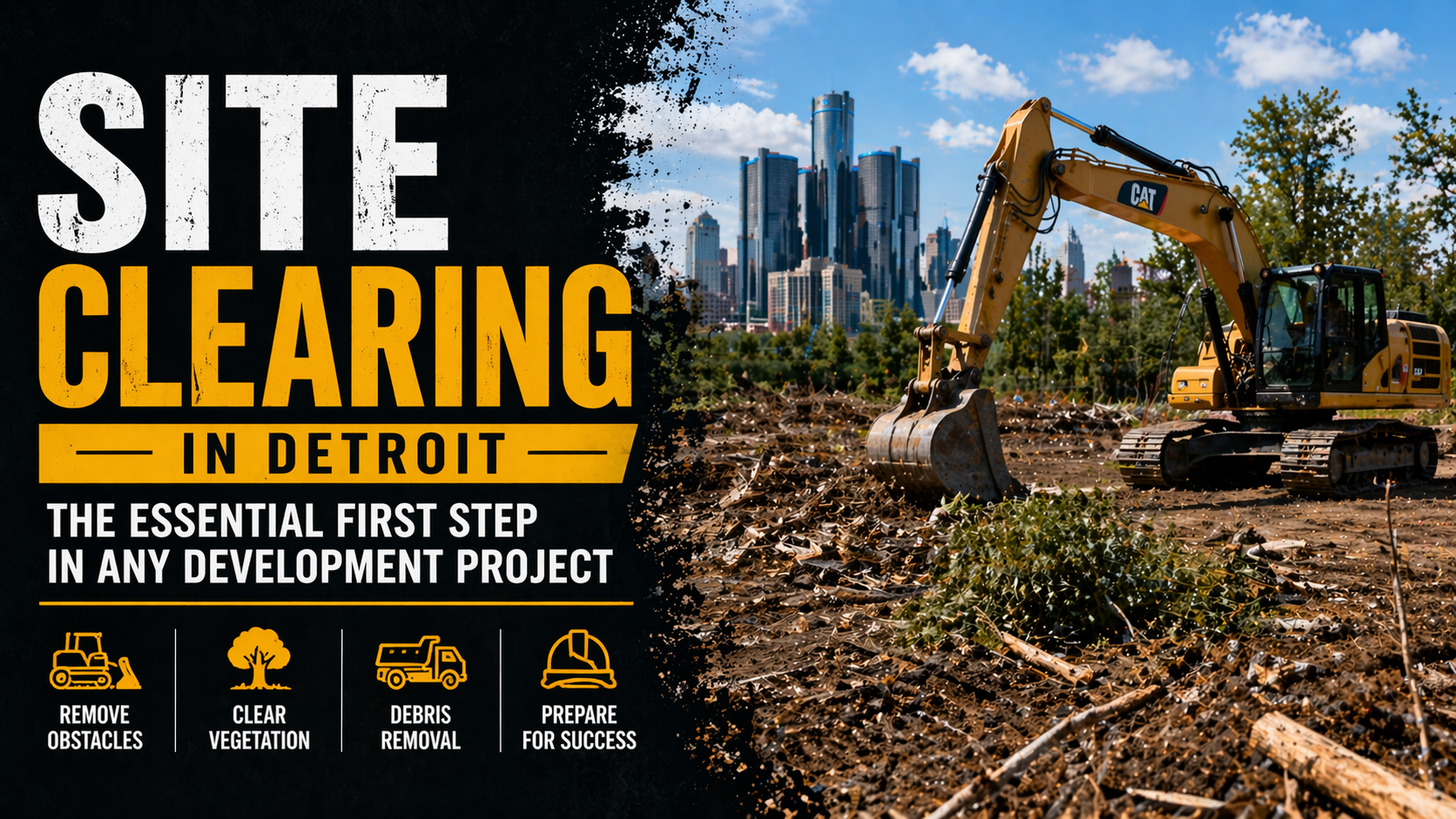
Every construction project whether a new home, a commercial building, a parking lot, or a landscape installation begins with the same fundamental requirement: a cleared and prepared site. Site Clearing Detroit is the process that makes everything else possible, transforming raw, undeveloped, or previously occupied land into a workable surface where engineers, surveyors, and construction crews can do their work effectively and safely.
In Detroit, site clearing has taken on added significance given the city’s ongoing revitalization. Decades of urban contraction left many neighborhoods with vacant lots, abandoned structures, and overgrown parcels that must be properly cleared before they can be put to productive new use. Understanding what site clearing involves and why it matters is essential for anyone planning a development or improvement project in the Detroit area.
What Is Site Clearing?
Site clearing is defined as the removal of all vegetation, debris, and existing structures from a designated area of land in preparation for construction or development. This includes trees, shrubs, brush, stumps, roots, rocks, soil contamination, old pavement, and any structures or materials that remain on the property from previous uses.
The scope of site clearing varies widely depending on the nature of the land and the requirements of the project. A vacant residential lot may only require removal of overgrown brush and a few trees, while a larger commercial or industrial site may involve the demolition of existing buildings, removal of subsurface materials, and significant earthmoving to create a buildable surface.
Why Site Clearing Is Critical
The importance of proper site clearing cannot be overstated. Skipping or inadequately completing this phase creates a cascade of problems throughout the rest of the project.
From a structural standpoint, vegetation particularly tree roots left in place beneath a construction area can cause significant problems over time. Decomposing organic material creates voids in the soil that lead to settling, and roots from nearby trees can continue to grow into and beneath foundations, causing cracking and structural damage. Removing all vegetation and root systems before construction ensures that the soil beneath a building or pavement is stable and free of biological material that could compromise it.
From a safety perspective, an uncleared site poses numerous hazards to construction workers. Overgrown vegetation can conceal buried debris, unstable ground, unmarked utility lines, and other dangers. A cleared and well-inspected site allows workers and equipment to move freely and safely, reducing the risk of accidents.
From a project efficiency standpoint, a properly cleared site allows surveying, layout, and construction to proceed without interruption. Construction equipment needs clear access routes, staging areas, and a defined workspace to operate efficiently. Attempting to build on a site that has not been properly cleared leads to delays, higher costs, and lower quality results.
The Site Clearing Process in Detroit
Site clearing in Detroit typically follows a sequence of steps tailored to the specific characteristics of the land and the requirements of the project.
The process begins with a thorough site assessment. Contractors evaluate what is present on the property trees, structures, underground utilities, areas of contamination, and any environmentally sensitive features such as wetlands or protected vegetation. Utility locating, coordinated through Michigan’s MISS DIG system, is completed before any clearing activity begins to prevent damage to underground infrastructure.
Permitting is the next step. In Detroit and surrounding municipalities, permits may be required for tree removal, demolition of structures, and significant land disturbance. The City of Detroit’s Buildings, Safety Engineering and Environmental Department handles permitting for demolition activities, while tree removal in certain areas may require review by local authorities.
With permits in hand and utilities marked, the physical clearing begins. For vegetation-heavy sites, this typically starts with manual cutting of brush and smaller trees, followed by the use of heavy machinery to remove larger trees, grind stumps, and clear debris. Excavators, bulldozers, and brush cutters are among the most commonly used equipment.
Debris from the clearing process is managed carefully. Recyclable materials such as wood are often chipped and processed; concrete and masonry are crushed and recycled as aggregate. Hazardous materials asbestos, lead paint, contaminated soil require specialized handling and disposal in compliance with Michigan Department of Environment, Great Lakes, and Energy (EGLE) regulations.
Once all surface and near-surface material has been removed, the site is inspected to ensure it is free of all organic and debris material. Grading and leveling may follow to bring the site to the required elevation and drainage condition for the next phase of work.
Site Clearing Methods
There are several established methods for site clearing, and the appropriate approach depends on the vegetation type, site size, terrain, and environmental considerations.
Conventional clearing uses bulldozers and excavators to push over trees and remove them root-ball and all. This method is effective for larger trees and heavily wooded sites but results in significant soil disturbance. The cleared material is then piled, hauled away, or burned in compliance with local ordinances.
Forestry mulching is an increasingly popular alternative that uses specialized grinding attachments mounted on track loaders or excavators to grind trees, brush, and stumps in place. The resulting mulch is left on the ground surface, where it decomposes, adds organic matter to the soil, and provides temporary erosion control. This method causes less soil disturbance than conventional clearing and eliminates the need to haul away and dispose of bulky tree material.
For urban sites with existing structures, site clearing includes demolition of buildings and removal of foundations, slabs, and buried infrastructure such as tanks or utility lines. This type of clearing is particularly relevant in Detroit’s urban renewal context, where former residential and commercial properties must be fully cleared before new development can occur.
Environmental Considerations
Site clearing can have significant environmental impacts, and responsible contractors take steps to minimize them. Erosion control measures silt fences, straw wattles, and temporary seeding are installed to prevent sediment from leaving the cleared site and entering stormwater systems during and after clearing activities.
In the Detroit area, some sites contain sensitive ecological features such as regulated wetlands, which are protected under both state and federal law. Clearing activities near wetlands must be carefully planned and may require permits from EGLE and the U.S. Army Corps of Engineers. Properly identifying and protecting these areas before clearing begins is both a legal requirement and an ethical responsibility.
Wildlife considerations are also part of responsible site clearing practice. Timing clearing activities to avoid nesting seasons for migratory birds and inspecting trees for active nests before removal are standard practices among professional clearing contractors.
Final Thoughts
Site clearing in Detroit is a multifaceted, technically demanding process that sets the stage for every successful construction and development project. Done correctly, it creates a safe, accessible, and well-prepared platform for the work that follows. Done poorly or incompletely, it creates problems that can persist throughout a project’s lifetime and beyond.
As Detroit continues its revitalization, professional site clearing services play a central role in converting underutilized properties into productive spaces that benefit both individual property owners and the broader community.